
RAG Chatbot for F&B Menu Consultation: Increase Order Value by 25-35%
The RAG Chatbot combines menu data with customer behavior to provide 24/7 personalized suggestions, increasing average order value by 25-35% for F&B chains. The article explains the operating mechanism, deployment process, and real-world case studies from Vietnamese restaurants.
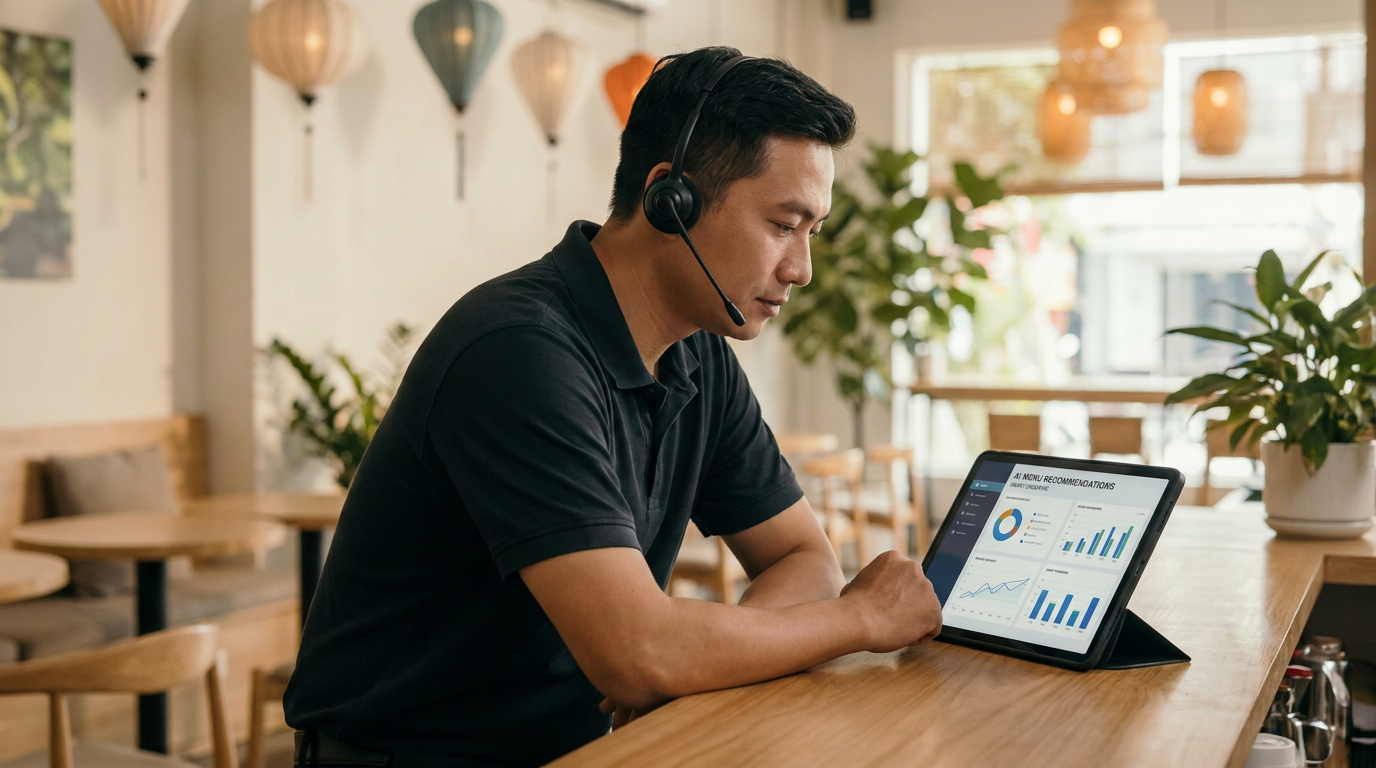
In Vietnam, restaurant chains with 5-50 branches face a challenge: customers need 24/7 menu consultation, but service staff cannot always be available, leading to high abandonment rates and lower order values than potential. RAG Chatbot (Retrieval-Augmented Generation Chatbot) is a new AI solution that combines menu data, purchase history, and customer preferences to provide personalized recommendations, increasing average customer revenue by 25-35% without hiring additional staff.
What is a RAG Chatbot for menu consultation?
A RAG Chatbot is an AI system combining 2 technologies: Retrieval (retrieving data from the menu, price, and promotion database) and Generation (creating natural, personalized responses). Unlike regular chatbots that only answer general questions, a RAG Chatbot “understands” each customer’s individual preferences (vegetarian, allergies, preference for Asian or Western dishes) to suggest suitable dishes and upsell naturally.
Short definition: RAG Chatbot = Menu data retrieval + AI-generated personalized suggestions, operating 24/7 without staff, increasing average order value by 25-35%.
What are the 3 main steps in the RAG Chatbot’s operating mechanism?
The RAG Chatbot operates through 3 steps: (1) The customer asks “I’m vegetarian and not allergic to seafood, what do you suggest?”, (2) The system retrieves vegetarian dishes without seafood from the menu database, along with prices and customer reviews, (3) The AI generates a personalized response + additional suggestions (drinks, desserts) based on the customer’s previous purchase behavior.
- Step 1 — Data Retrieval: The customer enters a question or request (e.g., “High-protein dishes under 150k”). The RAG system scans the menu database, filtering by criteria: price, ingredients, calories, star rating. Data is ranked by relevance score.
- Step 2 — Data Processing with AI: The retrieved data is fed into a Large Language Model (LLM) along with the customer’s context (purchase history, preferences, meal time). The LLM “understands” the request and decides the order of suggestions.
- Step 3 — Personalized Response Generation: The AI generates a natural response in Vietnamese, including additional suggestions (combos, drinks, desserts) and the reason (“Based on your history of liking tomatoes, I suggest…”). The response is recorded for learning in future interactions.
What benefits does RAG Chatbot bring to F&B chains in Vietnam?
RAG Chatbot helps F&B chains increase average customer revenue by 25-35% through natural upsells, improve customer experience from 4.2 stars to 4.7 stars, reduce consultation wait time from 5-10 minutes to 10-15 seconds, and save 30-40% on consultation staffing costs through automation.
- Increase Average Order Value (AOV): Personalized suggestions (combos, drinks, desserts) based on customer preferences help increase AOV by 25-35%. For example: a customer intends to order chicken rice for 89k, RAG Chatbot suggests adding strawberry juice for 25k + flan cake for 35k → the order increases to 149k.
- Improve Customer Experience (CX): Customers don’t have to wait for staff, receive suggestions 24/7, and don’t feel pressured to buy (suggestions are optional). This raises ratings from 4.2 to 4.7 stars on Google Maps / Zalo.
- Reduce Staffing Costs: No need to hire 2-3 additional consultation staff, saving 30-40% on monthly salary costs. Staff can focus on premium service skills and complex upsells.
- Detailed Customer Data: Every interaction with RAG Chatbot is recorded (eating habits, peak hours, dish preferences), helping management understand customers better for more accurate marketing.
How many stages are there in the RAG Chatbot deployment process for restaurants?
Deploying a RAG Chatbot consists of 5 main stages: (1) Menu data preparation, (2) Building a vector database, (3) Configuring the LLM and suggestion rules, (4) Integration into Zalo / website, (5) Testing and optimization based on customer feedback. The entire process takes 4-6 weeks from contract signing to go-live.
- Stage 1 — Data Preparation (Week 1-2): Export the menu list from POS (name, price, ingredients, calories, images, reviews). Clean the data, categorize dishes (appetizers, mains, desserts, beverages). Add metadata (cooking time, spiciness level, suitability with other menu items).
- Stage 2 — Building the Vector Database (Week 2-3): Convert menu descriptions into vectors (embeddings) so the RAG Chatbot can search quickly. Use tools like Pinecone, Weaviate, or Supabase Vector. Goal: search 100 dishes in <100ms.
- Stage 3 — Configuring LLM and Rules (Week 3-4): Connect the LLM (GPT-4, Claude, or Vietnamese models like Viettel AI). Write prompt templates so the RAG Chatbot understands customer requests (vegetarian, max price, avoid seafood). Configure upsell rules (if a customer orders rice, suggest drinks; if ordering for 2 people, suggest a combo).
- Stage 4 — Integration into Customer Channels (Week 4-5): Deploy the RAG Chatbot on Zalo Official Account (most popular), the restaurant’s website, or mobile application. Ensure the chatbot can handle Vietnamese, emojis, and specific restaurant context (branch name, opening hours).
- Stage 5 — Testing and Optimization (Week 5-6): Run a beta test with 10-20 loyal customers. Collect feedback (are suggestions relevant? Is there repetition? Does it understand Vietnamese?). Adjust prompts, add keywords, improve accuracy.
Comparison table: RAG Chatbot vs Traditional Chatbot vs Consultant Staff
| Criteria | RAG Chatbot | Traditional Chatbot | Consultant Staff |
|---|---|---|---|
| Personalization | High — based on purchase history, preferences | Low — answers generic questions | Very high — but depends on skill |
| Response time | 10-15 seconds | 5-10 seconds (but generic) | 3-5 minutes (waiting for staff) |
| Successful upsell rate | 18-22% | 5-8% | 25-30% (but high cost) |
| 24/7 operation | Yes | Yes | No (business hours only) |
| Monthly cost | 15-25 million (setup + API) | 5-10 million | 15-20 million (1 staff) |
| Information accuracy | 95-98% (data from POS) | 80-90% (may have errors) | 90-95% (humans may forget) |
Case study: La Me Restaurant (HCMC) increases revenue by 32% after 3 months of deploying RAG Chatbot
La Me Restaurant (chain of 8 branches, 120 employees) deployed a RAG Chatbot on Zalo in June 2024. Results: average order value increased from 285k to 375k (+32%), rate of customers buying add-ons increased from 12% to 28%, consultation waiting time decreased from 7 minutes to 20 seconds. Deployment cost 35 million (setup + 3 months API), ROI reached 180% after 3 months.
Common mistakes when applying RAG Chatbot
Mistake #1 — Unclean menu data: If the menu data in POS is faulty (misspelled names, outdated prices, blurry images), the RAG Chatbot will give wrong suggestions. For example: suggesting “Grilled chicken rice” but it’s actually “Roasted chicken rice”, confusing the customer. How to fix: Check 100% of menu data before importing into the vector database. Update prices, images, and ingredients weekly.
Mistake #2 — Prompt not suitable for Vietnamese culture: If the prompt is written in English or does not understand Vietnamese nuances (vegetarian = no meat, no fish, no shrimp, no eggs; diet = less salty, less oily), the chatbot will give inaccurate suggestions. For example: suggesting “Chicken rice” for a vegetarian customer.
Mistake #3 — Not integrating with the current POS: If the RAG Chatbot is not connected to the POS, the menu will be outdated (suggesting items that are out of stock, or not knowing today’s promotions). How to fix: Ensure the RAG Chatbot syncs data from the POS every 1-2 hours. If using VietPOS, there is a ready API for connection.
Mistake #4 — Being too greedy with upsell: If every response includes 3-4 additional suggestions, customers will feel “pressured” to buy and will close the chatbot. How to fix: Limit to a maximum of 2 additional suggestions, only suggest if the additional cost does not exceed 30% of the main dish price.
Mistake #5 — Not tracking metrics: If you don’t track the number of customer interactions, conversion rate, and feedback, you won’t know if the RAG Chatbot is effective. How to fix: Track weekly: number of interactions, upsell rate, AOV before/after, customer rating score. Adjust the prompt if necessary.
Which technology supports RAG Chatbot most effectively?
To deploy an effective RAG Chatbot, an F&B chain needs 3 main technologies: (1) Vector Database (Pinecone, Weaviate, Supabase) to store and quickly search menu data, (2) LLM (GPT-4, Claude, or Vietnamese models) to generate personalized responses, (3) Orchestration Platform (n8n, Make, Zapier) to connect the LLM, Vector Database, and customer channels (Zalo, website). Additionally, if the chain uses VietPOS Software 2026 — 8 major upgrades for multi-branch F&B chains, it can directly integrate the RAG Chatbot into the POS system via the API of VIET DUC TRI GROUP.
When should an F&B chain deploy a RAG Chatbot?
An F&B chain should deploy a RAG Chatbot when: (1) scale ≥ 5 branches (enough data volume for AI to learn), (2) menu ≥ 50 items (enough variety for personalized suggestions), (3) customers primarily use Zalo / app (easy to integrate), (4) current AOV < 350k (room for upsell), (5) has an IT team or partner to support deployment. If it’s just a small shop with 1-2 branches, it may be better to wait 1-2 more years when the technology is cheaper.
FAQ — Frequently Asked Questions
Can RAG Chatbot completely replace consultants?
Not entirely. RAG Chatbot is best as an “assistant” for employees, not a replacement. It handles 70-80% of basic consultation requests (menu suggestions, price searches), allowing employees to focus on high-level upselling (special menu combinations, VIP service), handling complaints, and creating emotional experiences that AI cannot deliver. Combining RAG Chatbot + skilled employees = the best results.
How much does it cost to deploy RAG Chatbot?
The cost of deploying RAG Chatbot consists of 3 parts: (1) Initial setup: 25-40 million VND (design, configuration, testing), (2) Monthly API costs: 8-15 million VND (depending on interaction volume — if 5,000 interactions/month, approximately 10 million VND), (3) Maintenance/optimization: 3-5 million VND/month. Total for the first year: 120-180 million VND. ROI typically reaches 150-200% after 3-6 months if applied correctly.
Can RAG Chatbot understand Vietnamese?
Yes, but it requires proper configuration. LLMs like GPT-4 and Claude support Vietnamese well (accuracy 90-95%). However, prompts must be written clearly in Vietnamese, understanding cultural nuances (vegetarian, dietary restrictions, allergies, etc.). If using Vietnamese models like Viettel AI or VinAI, accuracy can be higher at 95-98%.
How long does it take to deploy RAG Chatbot?
From contract signing to go-live takes 4-6 weeks: weeks 1-2 for data preparation, weeks 2-3 for building the vector database, weeks 3-4 for LLM configuration, weeks 4-5 for customer channel integration, weeks 5-6 for testing. If the chain uses VietPOS, this can be shortened to 3-4 weeks because data is already available in the system.
Is RAG Chatbot secure for customer information?
Yes, as long as it is deployed correctly. Customer data (purchase history, preferences) is encrypted during storage and transmission. However, you need to choose a vector database with security certifications (SOC 2, ISO 27001). If using a solution from Việt Đức Trí Group, data is stored in a data center in Vietnam with bank-grade security.
What if a customer complains about RAG Chatbot’s suggestions?
The RAG Chatbot system has a “feedback loop” function: if a customer clicks “Inappropriate suggestion,” that data is recorded. After 10-20 similar feedback entries, the system automatically adjusts the prompt or removes that suggestion. Additionally, employees can access the dashboard to view feedback and make manual adjustments if needed.
Is your F&B chain ready to apply RAG Chatbot to increase revenue? Contact VietPOS.AI deploying RAG knowledge assistant for a 50-store convenience chain immediately or call 0935 295 337 for a free consultation on RAG Chatbot solutions suitable for your scale and industry. The expert team at Việt Đức Trí Group will support you from A-Z: data preparation, deployment, testing, to go-live.